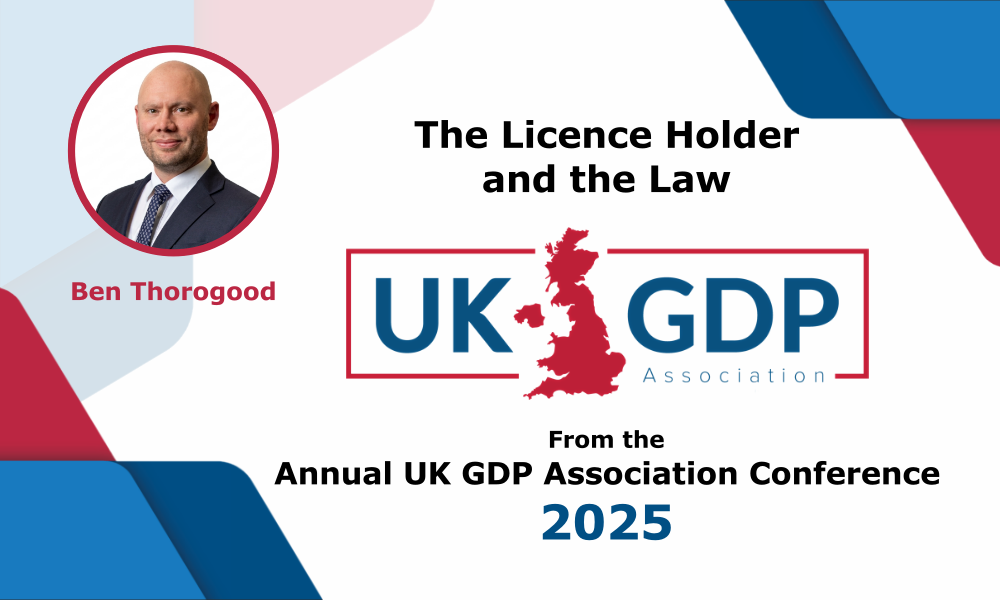
The Licence Holder and the Law
Insights from Ben Thorogood
Among the most eye-opening sessions at the 2025 UK GDP Association Annual Conference was The Licence Holder and the Law, delivered by legal expert Ben Thorogood. In a sector where compliance failures can escalate rapidly into legal and financial crises, Ben’s session served as a critical reminder of the legal obligations that underpin every Wholesale Distribution Authorisation (WDA), Quality Technical Agreement (QTA), and GDP-governed process. Ben brought exceptional clarity to a subject that can feel very abstract, until something goes wrong. Drawing on his own extensive experience supporting pharmaceutical organisations, Ben demonstrated just how easily regulatory missteps can turn into full-scale legal disputes.
Meet the Speaker – Ben Thorogood, Laytons LLP
Ben is a solicitor specialising in commercial litigation, regulatory disputes and legal risk management at Laytons LLP, a firm recognised for its expertise in life sciences, pharmaceutical compliance, and commercial law. His work has positioned him as a trusted adviser to Licence Holders, GDP regulated businesses, and organisations navigating complex supply chain or contractual challenges.
At Laytons, Ben routinely supports clients facing:
· Disputes regarding QTAs
· Contract breaches
· Supply chain failures
· Regulatory enforcement
· Litigation risk relating to quality failures
His deep understanding of both legal and GDP frameworks made his conference session invaluable for Responsible Persons (RPs), Licence Holders (LHs), and senior quality leaders.
Why Licence Holders Must Understand the Legal Landscape
“Regulatory breaches don’t just create compliance issues; they create legal exposure.”
Every GDP obligation and every contractual clause carries legal weight. While many businesses treat GDP as purely and operational or quality matter, the law does not make that separation. When something goes wrong, such as a failed audit, supply chain lapse, or QTA breach, the LH can quickly find themselves managing not only a regulatory problem, but also:
· Legal claims
· Financial damages
· Reputational harm
· Contractual disputes with suppliers or customers
Ben stressed that these issues are not hypothetical. They are increasingly common.
The Hidden Legal Risks of QTA breaches
One of the most frequently litigated issues Ben sees is the breach of Quality Technical Agreements.
A QTA governs:
· Obligations between parties
· Responsibilities for quality oversight
· Incident reporting
· Expectations for audits
· Risk management duties
· Supply chain operations
· Record-keeping standards
When one party fails to meet these obligations, whether due to incomplete audits, missing documentation, poor oversight, or misunderstood responsibilities, the legal consequences can be severe. “QTA breaches often form the backbone of litigation claims.” Ben explained. This is because they involve clear contractual obligations. When those obligations are not met, the legal exposure is significant.
Documentation: Your strongest, and often, your only legal defence
Perhaps the most powerful message from Ben’s session was that documentation is everything in a legal dispute. Regulators say it often, but in court, the rule is even harsher.
If it isn’t documented, it didn’t happen!
Ben outlined the types of documentation that are routinely disclosed in litigation, including:
· Company records
· CAPAs
· Deviations
· Audit reports
· Controlled notebooks
· Meeting minutes
· Internal emails
· Text messages
· WhatsApp communications
This list was an eye-opener for may delegates. Informal messages, especially WhatsApp discussions are legally disclosable and often become central evidence in disputes. Ben emphasised the importance of ensuring that:
· Decisions are documented
· Justifications are recorded
· Risks are logged
· CAPAs are traceable
· Changes follow correct procedures
In a legal challenge, the opposing side will scrutinise every detail!
The Cost of Getting it Wrong
The discussing the consequences of non-compliance, Ben was unequivocal:
“Legal claims are expensive, financially and reputationally.”
Costs can include:
· Legal fees
· Damages or settlement payments
· Lost business
· Increased regulatory attention
· Licence jeopardy
· Reputational fallout within the industry
For Licence Holders, the impact can be long-lasting. A single case can follow an organisation for many years, influencing future contracts, inspections, partnerships and customer retention.
Insurance: An often-overlooked safeguard
Another key takeaway was the importance of having the correct insurance coverage. Ben advised Licence Holders to:
· Review their policies annually
· Ensure coverage matches the true business model
· Understand what is and isn’t covered
· Check whether contract liability is included
· Check for any exclusions relating to regulatory breaches
The wrong insurance can leave a business dangerously exposed, and GDP organisation often change scope or activity levels over time, meaning that policy updates are essential.
Strengthening your Position
To reduce the risk of legal disputes, Ben recommended:
1. Thorough QTA Reviews:
a. During renewal
b. As a result of variations
c. When the scope changes
d. When there are operational changes
e. After audit findings
2. Routine audits to confirm compliance and to reduce exposure. Remember to document all findings.
3. Work collaboratively with suppliers and partners when issues arise. It is important to maintain open dialogue; litigation often stems from communication failures.
4. Seek early legal advice. If a dispute escalates, seeking timely specialist guidance can prevent a small issue becoming a large claim.
A Vital Sesson for Responsible Persons and Licence Holders
Ben’s presentation reminded delegates that GDP is not just a regulatory obligation, it is a legal framework with real consequences. It was a sobering but highly practical talk equipping GDP professionals to navigate the legal realities underpinning their work.
Registering for the 2026 Conference
There are discounted tickets available for UK GDP Association members, members can save £100 when attending both conference days. However, our commitment to low-cost, high-value educational content means that conference tickets will still be the best value whether you chose to join as members or not.
Membership is only £29 +VAT per individual, per year and offers reduced costs on consulting, training and conference tickets. If you buy tickets for both conference days, there is an even greater discount. Costs for non-members is just £224.50 per day, a fraction of the cost of other industry events!
In addition, on the evening of Tuesday 16th June, we will be hosting an evening event of dinner, networking, and even some of Dave’s infamous karaoke, for just £49 +VAT per person. This is a fundraising dinner in aid of the MVA Society.
Please see below for more information on the conference and to book your conference and evening dinner tickets.
- In-person conference and charity dinner tickets are available here.
- Virtual conference tickets are available here.
We are very much looking forward to seeing you all at the conference!
 2025 Conferences