Regulatory Agencies in UK and Ireland: Spot the Difference
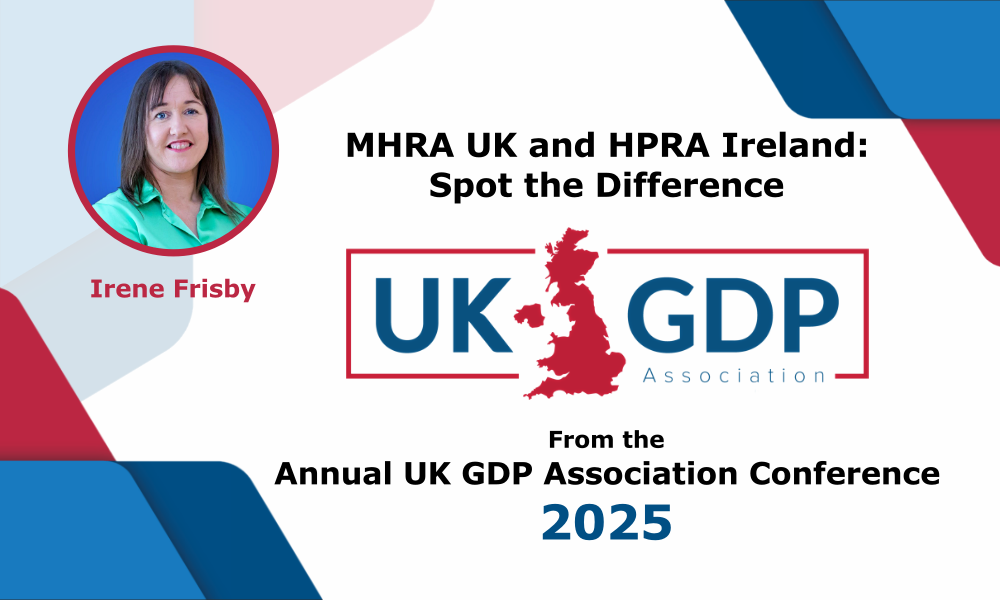
At the 2025 UK GDP Association Annual Conference, one session that drew strong interest from Responsible Persons, compliance leads, and distribution professionals was “MHRA and HPRA – Spot the Difference,” presented by Irene Frisby, Managing Director of FQS Pharma.
With regulatory requirements evolving across the UK and EU, delegates appreciated the clarity Irene brought to understanding how the Medicines and Healthcare products Regulatory Agency (MHRA) (UK) and Health Products Regulatory Authority (HPRA) (Ireland) regulate wholesale distribution and, importantly, what practical steps are needed for companies operating or expanding across both markets.
Her session was packed with real-world insights, regulatory comparison, and practical preparation guidance, all grounded in her extensive experience supporting businesses through Wholesale Distribution Authorisation (WDA) requirements and inspections.
About the Speaker: Irene Frisby
Irene Frisby is a highly experienced pharmaceutical compliance expert and the founder and Managing Director of FQS Pharma, a consultancy firm specialising in quality, regulatory, and GDP services for pharmaceutical manufacturers and distributors. Irene established the company in 2005, and over the past two decades she has built FQS into a trusted partner for national and international organisations seeking regulatory compliance, quality system support, and inspection readiness. She is actively involved in client projects on a day-to-day basis, both in the UK and Ireland.
About FQS Pharma
FQS Pharma is a pharmaceutical consultancy serving the UK, Ireland, and global markets from offices in both countries. The company supports pharmaceutical manufacturing and distribution organisations with a wide range of services including quality and regulatory consultancy.
FQS also provides end-to-end support for companies seeking wholesale licences, including GDP Quality Management System (QMS) design, documentation development, and inspection readiness, all tailored to meet local regulatory expectations, whether under the UK’s MHRA or Ireland’s HPRA frameworks.
Understanding the Differences: MHRA vs HPRA for WDA Holders
Irene’s session began by highlighting one of the most important distinctions for pharmaceutical distributors working across the UK and Ireland. While the MHRA oversees Wholesale Distribution Authorisations (WDAs) in the United Kingdom, Ireland’s WDAs are issued by the HPRA (Health Products Regulatory Authority), which operates under EU GDP requirements.
This regulatory difference isn’t just cosmetic, it affects licence requirements, inspection expectations, and operational oversight.
Irish WDA Requirements: What You Need to Know
A central focus of the session was Ireland’s requirements for holding a WDA, many of which are distinct from the UK’s approach:
Physical Site and Presence
To hold a WDA in Ireland, there must be a physical distribution site within the country that includes:
-
- A permanent premises location.
- At least one member of staff onsite.
- A computer system located onsite and available 24/7.
These criteria ensure the HPRA can effectively inspect and monitor operations. The Responsible Person does not need to be physically based in Ireland, but a robust risk assessment must demonstrate how compliance and oversight will be maintained if the RP is offshore.
Responsible Person (RP) Requirements
Before submitting a WDA application in Ireland, companies must have:
-
- An employed or contracted RP.
- If contracted, the RP must have a Technical Agreement (TA) outlining on-site responsibilities and how inspections will be managed.
Regardless of employment status, the RP must have at least six months’ experience in GDP and quality management systems, receive training on relevant legislation and company procedures, and have a formal job description in place.
Importantly, Irish WDAs also require a Deputy RP, who must be named on the licence and have documented procedures for deputised duties. This is not a requirement for MHRA WDA applications under the UK regime.
Outsourced Services and Qualification
Irene emphasised that any provider contracted to perform outsourced activities such as storage, transport, or third-party support must be audited and have a signed Quality Technical Agreement (QTA) in place. Demonstrating oversight and qualification of all outsourced partners is a key expectation of the HPRA.
Transport routes, storage conditions, and temperature control systems must also be validated and mapped, ensuring compliance with GDP principles throughout the supply chain.
Pre-Application Registration Steps
To register for a WDA in Ireland, organisations must:
-
- Register their company details on the EMA, SPOR, and OMS platforms.
- Complete the HPRA registration form and submit a detailed cover letter outlining their activities and planned compliance structure.
Following submission, an HPRA inspection will take place within 90 days, after which an inspection report is issued within 15 days. Companies then have the opportunity to accept or contest findings with documented responses.
Common HPRA Inspection Deficiencies
Irene also shared insights into frequent inspection findings seen across multiple clients.
These included:
-
- Insufficient RP oversight or unclear documentation.
- Incomplete or absent bona fide checks on customers and suppliers.
- QTAs missing, not properly signed, or signed by persons without the relevant authority.
- Audits not conducted on outsourced partners.
- Transport qualification not performed or poorly documented.
These common gaps reinforce the HPRA’s focus on both documented evidence and consistent operational control.
Imports and WDAs: A Key Clarification
Irene clarified that imports into Ireland are managed under a Manufacturer’s/Importer’s Authorisation (MIA) rather than a WDA.
This distinction is critical for companies whose activities span importation, distribution, and market release.
Takeaways for Delegates and GDP Professionals
The session delivered valuable practical insight for organisations operating across the UK–Ireland regulatory divide.
With ongoing shifts in supply chain structures, post-Brexit regulatory divergence, and continued integration of EU GDP principles in Ireland, Irene’s breakdown of HPRA expectations helped attendees walk away with actionable compliance guidance from foundational site requirements to nuanced inspection readiness tips.
As companies continue to expand and adapt their distribution networks across borders, sessions like this help demystify regulatory differences and equip professionals with knowledge they can apply immediately within their quality systems and operational planning
Is there a seat reserved for you? Registering for the 2026 conference
The UK GDP Association C.I.C (Community Interest Company) is delighted to announce that our third Annual Conference will be held on Tuesday 16th June 2026 and Wednesday 17th June 2026, in Northampton.
There are discounted tickets available for UK GDP Association members, members can save £100 when attending both conference days. However, our commitment to low-cost, high-value educational content means that conference tickets will still be the best value whether you chose to join as members or not.
Membership is only £29 +VAT per individual, per year and offers reduced costs on consulting, training and conference tickets. If you buy tickets for both conference days, there is an even greater discount. Costs for non-members is just £224.50 per day, a fraction of the cost of other industry events!
In addition, on the evening of Tuesday 16th June, we will be hosting an evening event of dinner, networking, and even some of Dave’s infamous karaoke, for just £49 +VAT per person. This is a fundraising dinner in aid of the MVA Society.
Please see here for more information on the conference and to book your conference and evening dinner tickets.
We are very much looking forward to seeing you all at the conference!
 2025 Conferences